What is Antenna VSWR?
Understanding VSWR: The Basics
To understand VSWR, we first need to look at how power moves through an RF system.
In an ideal system, an RF transmitter generates signals and sends them through a coaxial cable to the antenna. The antenna then radiates 100% of that energy into the air.
However, RF energy behaves like water flowing through a pipe. If the "pipe" changes size abruptly, some of the water bounces back. In electronics, if there is an electrical impedance mismatch between the transmitter, the transmission line (cable), and the antenna, not all the power can be transmitted.
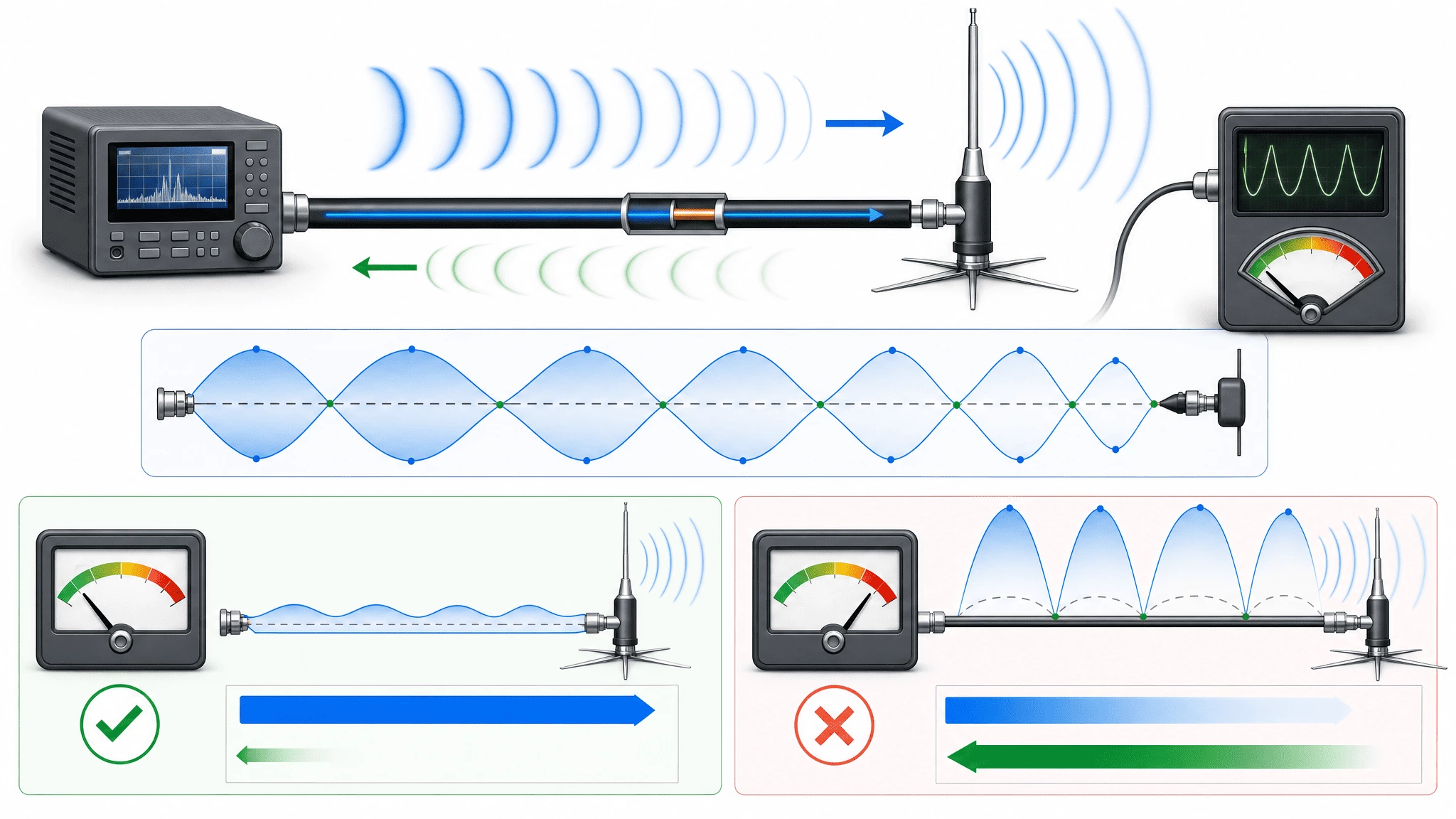
[RF Impedance Mismatch and Signal Reflection Diagram]
The power that cannot be radiated is reflected back down the cable toward the transmitter. The forward wave and the reflected wave collide inside the cable, creating a stationary interference pattern known as aStanding Wave.
VSWR (Voltage Standing Wave Ratio)is the mathematically derived ratio between the maximum voltage and the minimum voltage found along that standing wave. It measures how efficiently RF power is transmitted from the power source through a transmission line into the antenna.
The Mathematics of VSWR
For technical clarity, VSWR is expressed as a ratio, such as1.5:1or2.0:1.
It is calculated using theReflection Coefficient(Γ), which represents the ratio of the reflected wave voltage to the incident (forward) wave voltage. Alternatively, it can be viewed in terms ofReturn Loss(expressed in dB) orReflected Power Percentage.
Here is a quick reference table to help visualize how VSWR numbers translate to real-world performance:
| VSWR | Return Loss (dB) | Reflected Power (%) | Radiated Power (%) | System Status |
| 1.0:1 | ∞ | 0% | 100% | Perfect (Theoretical Ideal) |
| 1.2:1 | 20.8 | 0.8% | 99.2% | Excellent (High-end Antenna) |
| 1.5:1 | 14.0 | 4.0% | 96.0% | Good / Acceptable for most RF systems |
| 2.0:1 | 9.5 | 11.1% | 88.9% | Marginal (Needs investigation) |
| 3.0:1 | 6.0 | 25.0% | 75.0% | Poor (Critical Power Loss / High Risk) |
Why VSWR Matters for Your RF System
An optimized VSWR is not just a vanity metric; it directly impacts the longevity, reliability, and range of your communication network. Here is why keeping your VSWR low is vital:
1. Preventing Hardware and Power Amplifier Damage
When a high percentage of RF power is reflected back toward the transmitter (e.g., at a VSWR of 3.0:1 or higher), that energy has to go somewhere. It turns into heat inside the transmitter's Power Amplifier (PA). Over time, or instantly at high wattages, this thermal stress can fry delicate RF components, causing expensive equipment failure.
2. Maximizing Signal Range and Coverage
If your system has a poor VSWR, you are wasting valuable energy. Power turned into reflected standing waves is power that never leaves your antenna. A high VSWR directly reduces your Effective Radiated Power (ERP), shortening the overall distance your signal can travel and creating dead zones in your coverage.
3. Maintaining Signal Integrity
Reflected waves bouncing back and forth within the coaxial cable can cause phase distortion and signal degradation. In digital communication systems like 4G/5G or LoRa, this can result in higher Bit Error Rates (BER), dropped packets, and slower data speeds.
What Causes Poor VSWR?
A high VSWR reading during installation or routine testing is a symptom of an underlying issue. Common culprits include:
- Frequency Mismatch:Antennas are tuned to operate within specific frequency bands. Operating a UHF antenna at VHF frequencies will result in a severe impedance mismatch.
- Damaged Coaxial Cables:Kinks, sharp bends, water ingress, or crushed sections change the internal geometry of the cable, altering its characteristic impedance (50 Ω is the industry standard).
- Poorly Installed Connectors:Loose, corroded, or badly crimped RF connectors introduce significant reflection points.
- Environmental Obstructions:Placing an antenna too close to metal structures, concrete walls, or other antennas can distort its radiation pattern and raise the VSWR.
Conclusion: Setting the Standard for RF Excellence
In practical field applications, a VSWR of1.5:1 or loweris considered the industry benchmark for a healthy, efficient wireless system.
When sourcing hardware, investing in precision-engineered antennas and high-quality, low-loss coaxial assemblies is the most effective way to guarantee a stable VSWR. By ensuring that components are strictly manufactured to precise impedance tolerances, you protect your active transmitters and maximize transmission efficiency.
Are you experiencing signal degradation, or planning a new wireless deployment that requires rock-solid RF performance? Explore our comprehensive range of high-performance base station, mobile, and customized antennas, or [contact us] to speak with our engineering support team today.