MWC 2026: Key Technologies Behind Qualcomm’s 6G Prototype
MWC 2026: What “Black Technologies” Are Inside Qualcomm’s 6G Prototype?
The MWC Barcelona 2026 (Mobile World Congress 2026) is about to open.
Major players in the communications industry will showcase their most significant innovations on this global stage. Over the next few days, I will continue tracking industry highlights and emerging trends.
Today, let’s first take a look at the technological innovation that Qualcomm, one of the industry leaders, will bring: an end-to-end 6G prototype system.
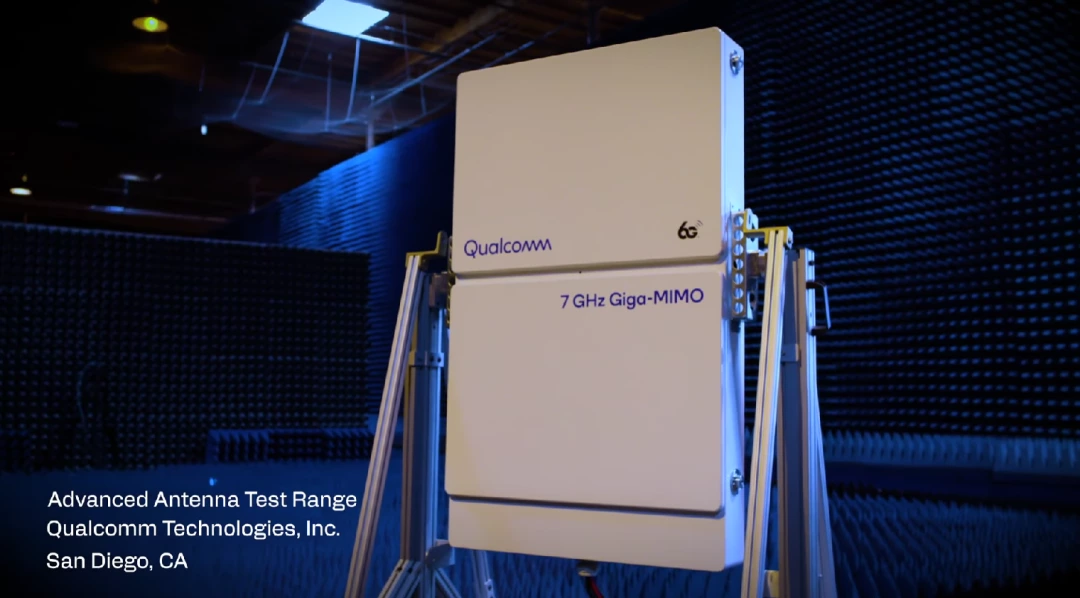
End-to-End 6G Prototype System | Qualcomm on YouTube
In its official video release, Qualcomm demonstrated the core architecture of this prototype system:
Giga-MIMO Technology
The prototype adopts Giga-MIMO, an upgraded version of 5G Massive MIMO, featuring far more antenna elements and transceiver channels, significantly increasing network capacity.
In 5G systems, base stations typically use 192 antenna elements with 32 or 64 transceiver channels.
Qualcomm’s prototype operates in the 7 GHz band and integrates 2048 antenna elements, supporting 256 transceiver channels.
Probabilistic Amplitude Shaping (PAS)
The system uses a modulation technique called Probabilistic Amplitude Shaping (PAS).
Without increasing bandwidth or power consumption, PAS can significantly improve spectral efficiency, coverage, and energy efficiency, pushing performance closer to the Shannon capacity limit.
Subband Full Duplex (SBFD)
The prototype also introduces Subband Full Duplex (SBFD) technology.
Each subband has its own independent antenna array. Within a 400 MHz carrier bandwidth, the spectrum is divided into two subbands, enabling simultaneous high-speed uplink and downlink transmission with extremely low latency.
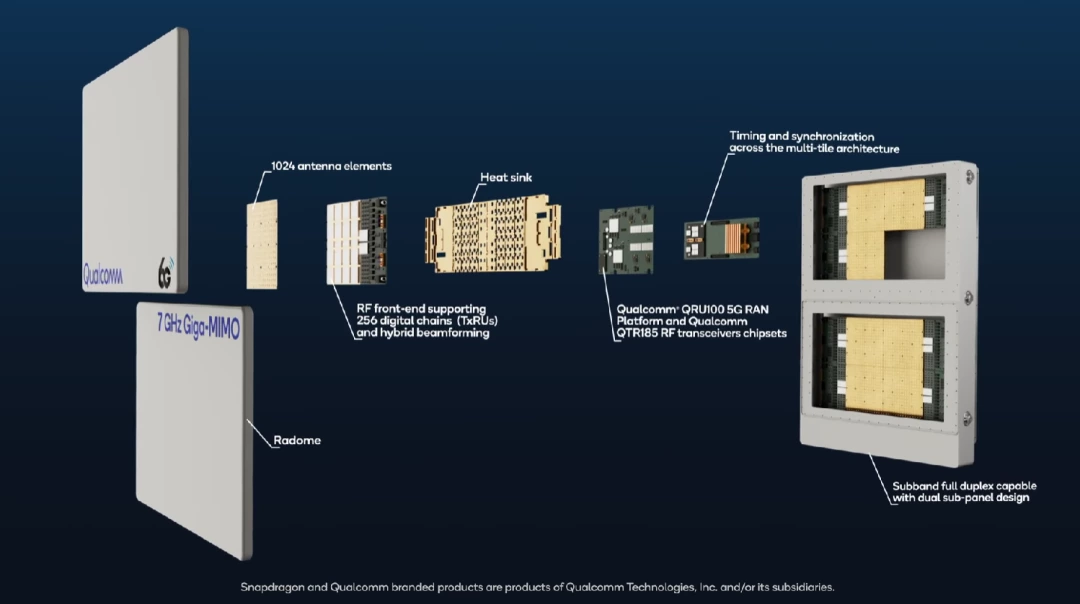
6G Prototype Architecture Breakdown | Qualcomm on YouTube
In the test configuation:
Downlink:
300 MHz bandwidth / 8 layers / 1024QAM
Uplink:
100 MHz bandwidth / 4 layers / 256QAM
The results achieved:
Downlink speed exceeding 16 Gbps
Uplink speed exceeding 2 Gbps
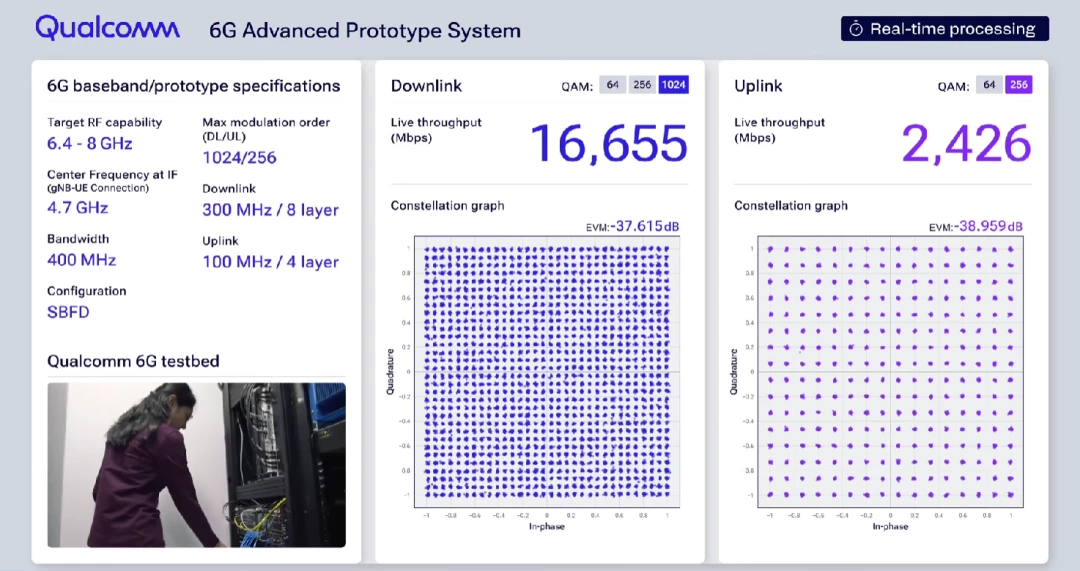
6G Prototype Test Configuration & Results | Qualcomm on YouTube
Key Technologies Behind the Prototype
Giga-MIMO: Massive Antenna Arrays
During the 5G era, Massive MIMO has already been widely deployed.
The hardware foundation of Massive MIMO is the large-scale antenna array, typically consisting of 192 antenna elements with 32 or 64 transceiver channels.
In the 6G era, Massive MIMO evolves into Giga-MIMO.
The word “Giga”, derived from Greek, means enormous. At this level, antenna arrays typically contain thousands of elements.
Qualcomm’s 7 GHz prototype integrates:
2048 antenna elements
256 transceiver channels
This is roughly ten times larger than conventional 5G Massive MIMO systems, enabling much higher throughput.
Why Can 2048 Antenna Elements Fit in the Device?
The reason lies in the relationship between antenna spacing and wavelength.
Wavelength is inversely proportional to frequency:
When frequency doubles, wavelength halves.
Compared with the mainstream 5G 3.5 GHz band, the 7 GHz band has a shorter wavelength, allowing more antenna elements to be packed into the same physical space.
In Qualcomm’s 13 GHz 6G prototype, the antenna count reaches 4096 elements.
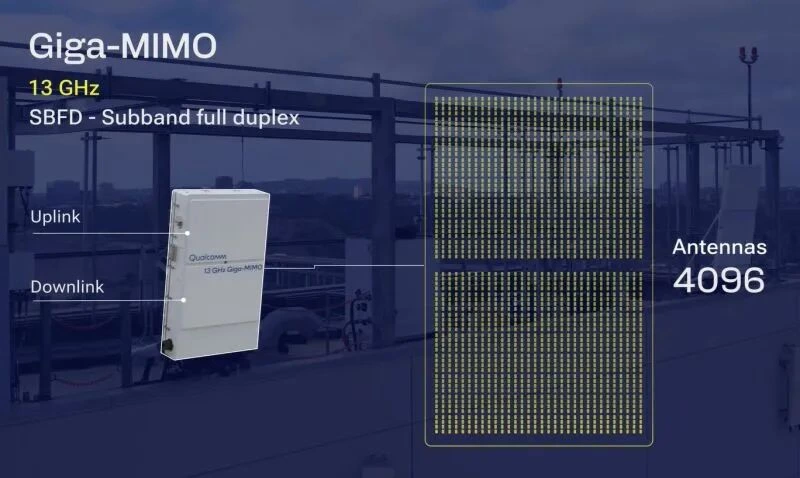
Giga-MIMO: Unlocking 6G Potential | Karem Alomari on LinkedIn
Such massive MIMO systems naturally introduce complex signal processing and power management challenges, which is where AI becomes essential.
Therefore, AI-native base stations are considered a key foundation for enabling Giga-MIMO.
With large-scale antenna arrays combined with AI algorithms, spatial beamforming capability is significantly enhanced.
This allows 6G base stations to generate extremely narrow and precise beams, enabling higher-frequency deployments while maintaining similar site spacing to 5G.
This means existing base station sites can potentially be reused during 6G deployment—an extremely important advantage.
Probabilistic Shaping: Approaching the Shannon Limit
In traditional QAM modulation, all constellation points are transmitted with equal probability.
For example:
In 64QAM, the constellation contains 64 points, each representing 6 bits of information. The specific point transmitted depends on the data bits.
Statistically, each constellation point appears with equal probability, which is called a uniform distribution.
However, this approach has limitations.
Points at the edges of the constellation have larger amplitudes and higher energy, while points near the center require less energy.
If all points are transmitted with equal probability, the transmitter must maintain a higher average power to support the outer points, reducing efficiency when SNR fluctuates.
How Probabilistic Shaping Works
Probabilistic shaping introduces an additional encoding algorithm.
Instead of mapping bits directly to fixed symbols, the system processes large groups of symbols, allowing it to control the probability distribution of constellation points.
The result:
Low-energy symbols appear more frequently
High-energy symbols appear less frequently
This adjustment makes the signal distribution closer to a Gaussian distribution.
Communication theory shows that Gaussian-distributed signals achieve the highest spectral efficiency in AWGN channels.
Test results show that after applying probabilistic shaping:
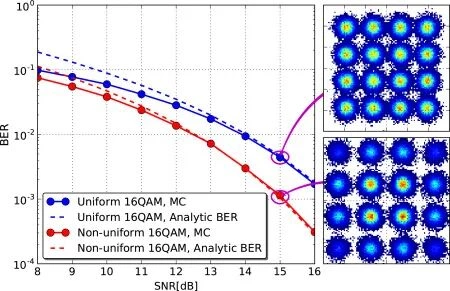
Bit error rate significantly decreases under the same SNR
Spectral efficiency improves by approximately 15–30%
Subband Full Duplex: Building FDD Within TDD
Since the 3G era, mobile data traffic has grown rapidly.
At that time, traffic was highly asymmetric, with downlink traffic far exceeding uplink.
TDD (Time Division Duplex) could allocate more time slots for downlink, making it more suitable for such traffic patterns.
In the 5G era, the rise of live streaming and user-generated content has significantly increased uplink traffic.
Looking toward 6G, emerging applications such as:
Immersive communications
AI-driven communications
Intelligent agents
will demand higher uplink bandwidth and ultra-low latency.
This requires a better balance between uplink and downlink.
However, most large bandwidth resources are TDD-based.
The Solution: Subband Full Duplex
The solution is to introduce FDD-like operation within TDD spectrum.
By dividing the TDD bandwidth into:
Downlink subbands
Uplink subbands
uplink and downlink can transmit simultaneously, achieving both high throughput and low latency.
This technology is called Subband Full Duplex (SBFD).
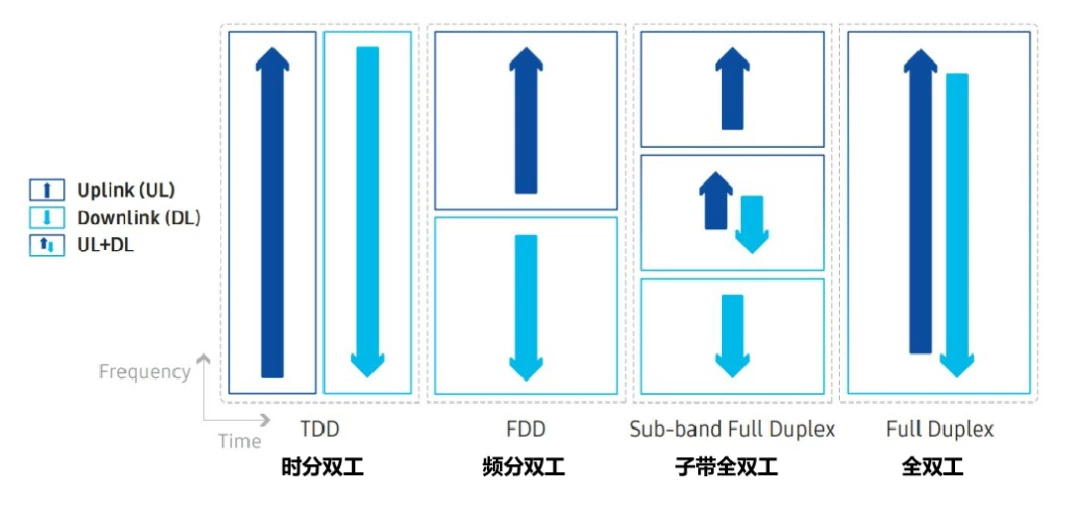
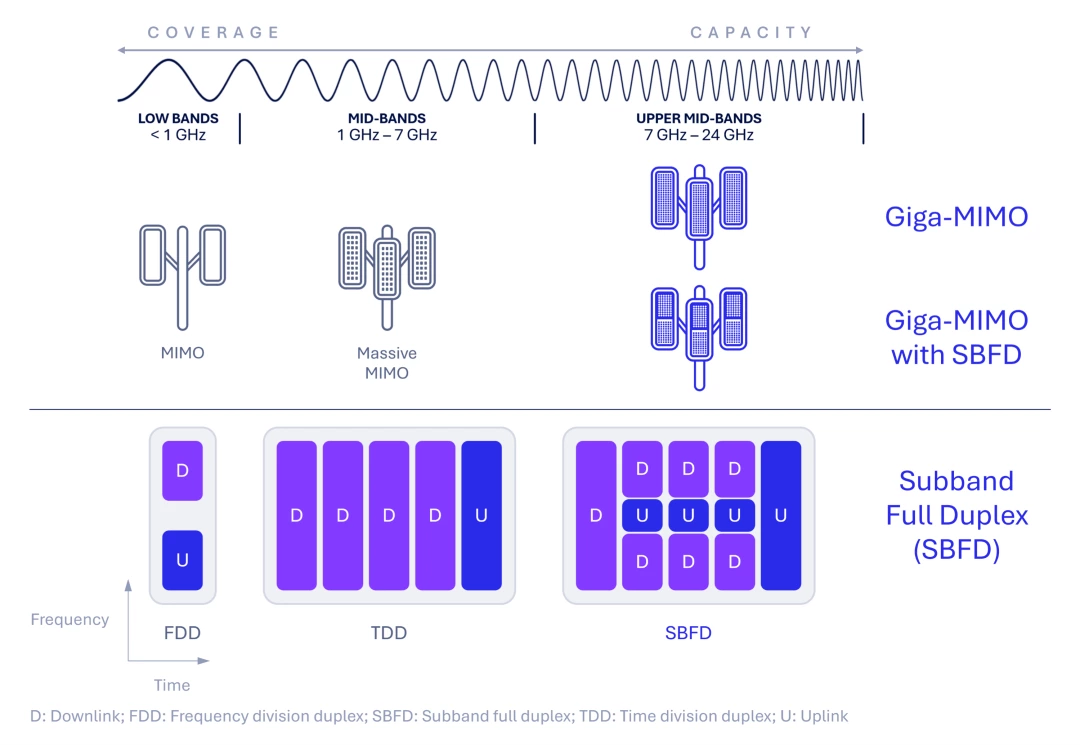
To support SBFD, the most critical challenge is interference cancellation between uplink and downlink signals.
Qualcomm’s prototype uses separate antenna arrays to improve transmit–receive isolation.
Conclusion
Time moves forward, and so does the evolution of wireless communications.
It feels like just yesterday that we were discussing the 5G industry ecosystem and deployment strategies, yet today the industry is already looking ahead to 6G.
Building upon the momentum of 5G, China has already launched its 6G research efforts through the IMT-2030 Promotion Group and leading enterprises, aiming to secure a strong position in future 6G standards and applications.
By 2030, 6G is expected to usher in a new era of “intelligent connectivity everywhere.”
6G is not the end of speed—it is the beginning of intelligence.
Let us look forward to how this next generation of wireless technology will illuminate the future.