Spain allows amateur radio enthusiasts to continue using the 40MHz band for another 18 months with a maximum power limit of 25 watts.
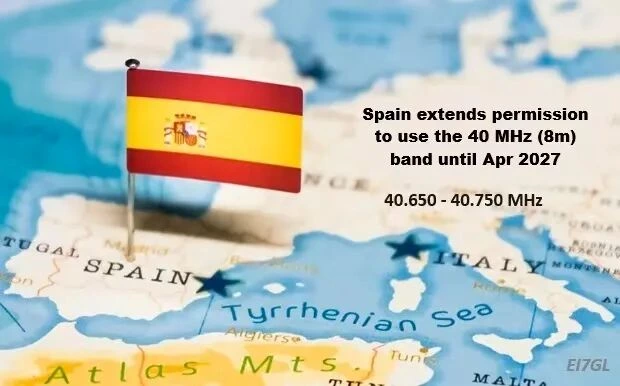
Great news! Amateur radio operators in Spain may continue operating on the 40 MHz band for another 18 months.
Recently, the Spanish Secretary of State for Telecommunications and Digital Infrastructure officially issued a resolution, allowing local amateur radio enthusiasts to continue using the 40MHz (8-meter band) frequency range with the license period extended by 18 months. This news is of great significance to Spain's amateur radio community: it not only serves as recognition of previous experimental results, but also grants more ample time for in-depth exploration of this frequency range. Below is a full review of the incident's background and developments.
First Authorization: Launching the Experimental Chapter of the 8-Meter Band
The incident dates back to April 2024. Prior to this, the demand among Spanish amateur radio enthusiasts for using the 40MHz (8-meter band) had been growing steadily. As the low-frequency part of the very high frequency (VHF) spectrum, this band combines the propagation characteristics of high frequency (HF) and VHF, making it an ideal frequency range for scientific research such as ionospheric propagation and solar activity. Internationally, only a few countries have opened it to amateur radio enthusiasts.
To respond to the community's needs, the Unión de Radioaficionados Españoles (URE) took the initiative to apply to the Spanish telecommunications authority for the temporary opening of the 40MHz band for enthusiasts' experimental use. On April 2, 2024, upon approval by the Spanish Secretary of State for Telecommunications and Digital Infrastructure, the 40.650–40.750MHz band was officially authorized for opening. Enthusiasts holding a Spanish amateur radio license are allowed to operate fixed stations within this range, with the maximum peak envelope power (PEP) limited to 25 watts and the authorization period set at 18 months.
In addition, the authorization specified clear operating rules: before operating on this band for the first time, enthusiasts must file a report with the Provincial Telecommunications Inspection Headquarters (JPIT) of their place of residence via digital certificate or electronic certification to ensure compliant and traceable operations. This requirement not only maintains order in band usage but also facilitates subsequent supervision.

The Unión de Radioaficionados Españoles (URE) had already applied to the Spanish licensing authority for permission to use the 40MHz (8-meter band) as early as 2023.
Based on detailed application materials, Spanish amateur radio enthusiasts were granted permission to conduct 18-month communication activities in the 40.650 to 40.750 MHz band, with the maximum peak envelope power limited to 25 watts.
As the first 18-month period drew to a close, URE compiled a detailed report outlining the achievements of Spanish amateur radio enthusiasts in the 40MHz band, which was officially released in September 2025.
The key findings of the study include:
- Research period from June 2024 to July 2025
- Covering contacts and reports from 60 countries across six continents
- Successfully established contacts with all European countries that allow the use of 40MHz (8-meter band) via sporadic E-layer propagation, with recorded communication distances ranging from 500 to 3,000 kilometers
- Established communication paths to the following countries via F2-layer propagation: Australia, Canada, Cuba, the United States, Cayman Islands, Mexico, New Zealand, Puerto Rico and the Dominican Republic. Notably, communication with Australia exceeded 14,000 kilometers, with the best communication day on October 20th
- Established an impressive 19,467-kilometer communication path to New Zealand and successfully received the ZL28M beacon operated by ZL2WHO. The beacon operates in FT8 mode with only 10 watts of power and a 3-element Yagi antenna aimed atEurope
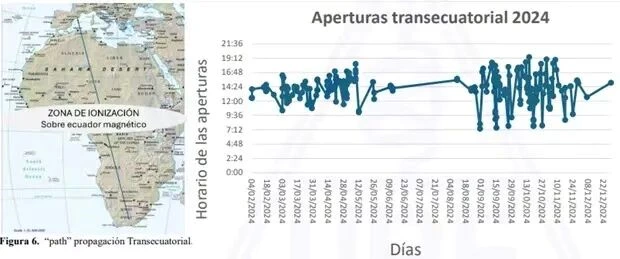
- From March to April 2024, signals from the South African ZS6WAB/B beacon were received almost daily via F2-layer propagation along trans-equatorial paths.
- As of the report's compilation, no evidence of harmful interference caused by the 40MHz band to other services has been found.
99.9% of communications were achieved through the application of the FT8 digital communication mode.
In response to the detailed application materials, the Spanish licensing authority has approved a 18-month extension of the license period starting from October 18, 2025.
Meanwhile, the maximum power limit has been increased from 25 watts to 100 watts peak envelope power (PEP).
Regarding the extension of the 40MHz band license, the Unión de Radioaficionados Españoles (URE) stated:
"This new resolution places Spain among a growing number of European countries—all members of the European Conference of Postal and Telecommunications Administrations (CEPT)—that permit experiments in the 40MHz band. This band has attracted much attention for its significant value in ionospheric propagation research and solar activity monitoring.Under the coordination of the Unión de Radioaficionados Españoles, the Spanish amateur radio community has demonstrated exceptional technical capabilities, a rigorous scientific approach and a high sense of operational responsibility. It has not only contributed to generating internationally valuable data, but also consolidated the status of amateur radio as a practical technological tool."Victor (callsign EA7FUN), President of the Unión de Radioaficionados Españoles, said: "The extension of this authorization is recognition of the association's rigorous work and demonstrates the value of amateur radio to scientific research. We will continue to collaborate with government departments to ensure Spain maintains a leading position in the field of radio communication technology experiments."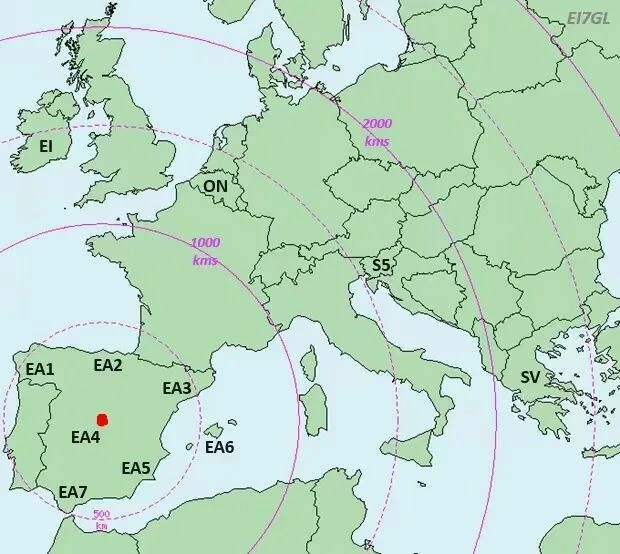
To sum up, this incident is of great significance to the 40MHz band. Major European countries have not only extended the license period by 18 months but also approved a higher power class, setting an important precedent for other countries looking to open up the 8-meter band.
Amateur radio associations of various countries may submit applications to their national licensing authorities, taking Spain as an example which has successfully implemented a limited licensing policy without causing any interference issues.