Marine VHF Antennas: Resolving Corrosion and Range Challenges in Offshore Communication
Marine VHF Antennas: Resolving Corrosion and Range Challenges in Offshore Communication
In offshore and maritime environments, a VHF radio is a critical lifeline for navigation, fleet operations, and search-and-rescue. However, marine communication hardware faces two relentless enemies: severe environmental degradation and the physical limits of line-of-sight signal propagation. To ensure reliable transmission under the harshest conditions, vessel operators and fleet integrators must carefully evaluate their antenna materials, mounting height, and radiation patterns.
1. Conquering the Elements: Anti-Corrosion Materials
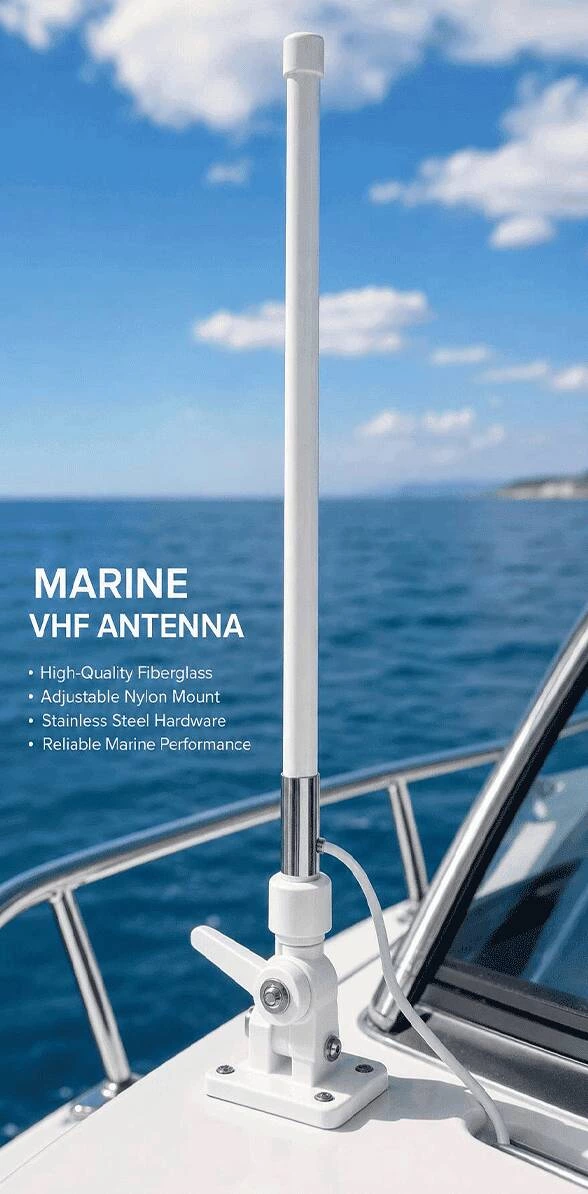
Unlike terrestrial installations, marine antennas are subjected to constant saltwater spray, high winds, and intense UV radiation. Standard plastics and untreated metals will rapidly degrade, leading to connection failures and structural snaps. To survive long-term exposure, professional maritime antennas are constructed with a solid fiberglass body featuring a glossy anti-UV finish that protects against sun damage and saltwater corrosion.
The internal elements of high-quality VHF antennas are often made from brass to ensure excellent signal transmission while resisting corrosion. Additionally, mounting hardware is a common point of failure. Industry experts advise utilizing corrosion-resistant dual-swivel nylon bases or stainless steel mounts rather than standard plastic. To maintain the protective finish, antennas should only be washed with non-abrasive soap and water, avoiding harsh detergents that strip the UV blockers.
2. The Physics of Range: Calculating Radio Horizon
VHF radio waves propagate quasi-optically, meaning they travel in straight lines. Because they do not penetrate the earth, the maximum communication distance is limited by the curvature of the earth, commonly referred to as the radio horizon. The higher the antenna is mounted, the further the signal can travel before hitting this barrier.
In ideal conditions, the mathematical equation to calculate the maximum range (in nautical miles) between two vessels is based on the square root of their antenna heights. The formula is expressed as:
Distance (nm) = 1.23 × (√height of antenna A + √height of antenna B)
For example, if two vessels both have antennas mounted 18 feet and 12 feet above the waterline respectively, the maximum communication range is approximately 9.48 nautical miles. Because height is so vital, sailboats have a distinct advantage as a shorter antenna mounted high atop a mast can effectively communicate over great distances. A well-installed system communicating ship-to-shore (where coastal stations have significantly taller towers) can achieve ranges up to 60 to 100 nautical miles.
3. Gain Selection: Coping with Pitch and Roll
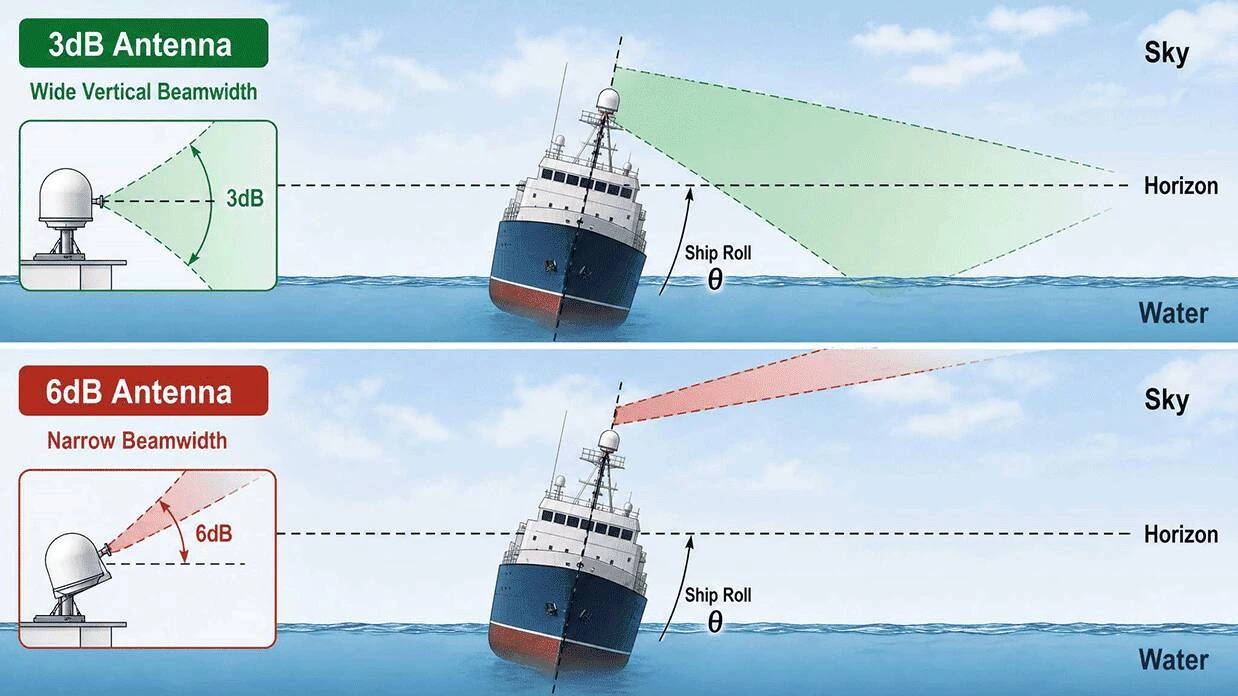
When selecting a Marine VHF Antenna, buyers must choose the appropriate 'gain' (usually measured in dB or dBi), which changes the shape of the signal. The higher the gain, the more the signal is squashed; instead of broadcasting evenly like an apple, a high-gain signal resembles a flat peach or a narrow disc.
- 3dB Antennas: These lower-gain antennas provide a balanced, wider vertical signal. This is ideal for smaller boats that frequently roll and pitch in heavy seas, as the wider beam ensures the signal stays directed at the horizon.
- 6dB to 9dB Antennas: Higher gain antennas offer superior range, but their narrow beam can shoot up into the sky or down into the water as the vessel rolls. These are best suited for large, stable platforms like commercial ships or fixed land-based stations.
4. Cable Integrity: Defeating Attenuation
A high-quality antenna is useless if the signal is lost within the coaxial cable before it even reaches the radio. The length of your cable run dictates the thickness and quality of the wire required. As a rule of thumb provided by maritime communication experts, standard RG58 coaxial cable is only sufficient for short runs up to 10 meters. If your installation requires routing cable up a tall mast (up to 30 meters), upgrading to thicker, lower-loss RG213 cable is mandatory to prevent severe signal attenuation.
Equip Your Fleet with Industrial-Grade Connectivity
At our manufacturing facility, we produce OEM maritime antennas engineered to withstand extreme oceanic environments. From custom fiberglass radomes to heavy-duty stainless steel mounting hardware and custom-length low-loss cabling, we provide comprehensive B2B communication solutions. Contact our engineering team today to request a quote for your marine fleet or wholesale distribution network.